
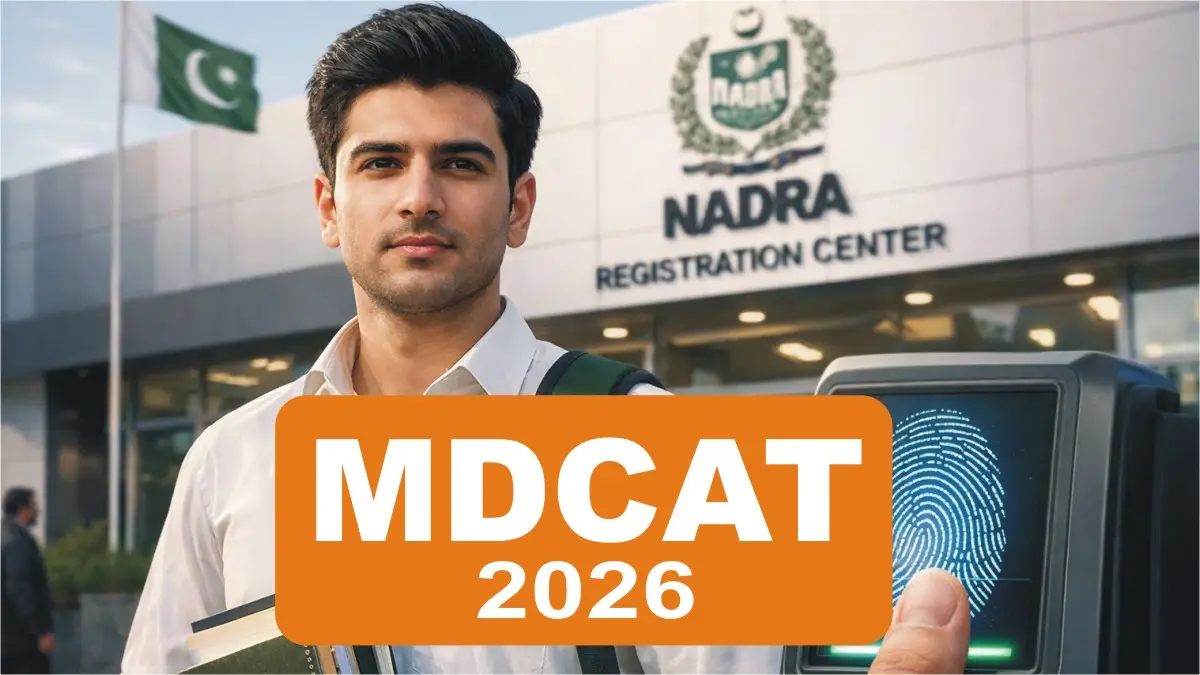
The Pakistan Medical and Dental Council (PMDC) has officially mandated biometric verification and Juvenile Registration Cards (JRC) for all MDCAT 2026 candidates. This landmark policy aims to eliminate identity fraud and ensure that only legitimate students secure admissions in Pakistan’s highly competitive medical and dental colleges starting from the 2026 academic session.
The “Pulse” Analysis
The medical entrance exam in Pakistan, commonly known as the MDCAT, has long been the subject of intense scrutiny. For years, allegations of “proxy candidates”—where professional exam-takers sit in place of the actual student—have plagued the system. The Pakistan Medical and Dental Council (PMDC) is now taking a decisive stand to protect the meritocracy that underpins the nation’s healthcare future.
The core of the 2026 reform rests on two pillars: Biometric Authentication and NADRA Integration.
- Identity Locking: By requiring biometric scans at the entry point of examination centers, the PMDC is effectively closing the door on impersonation. The system will match the student’s live fingerprints against the NADRA database in real-time.
- The End of the B-Form Era: Traditionally, students under 18 used their “B-Form” for identification. However, B-Forms lack the sophisticated security features and updated biometric data found in modern smart cards. The introduction of the Juvenile Registration Card (JRC) as a mandatory document bridges this security gap.
- Data Integrity: This move allows the PMDC to create a clean, digital trail for every applicant. From the moment a student registers to the moment they receive their final placement, their identity remains verified and immutable.
Why This Matters for the Medical Profession
Medicine is a field built on trust and ethics. When the entry point to this profession is compromised by cheating or fraud, the quality of future doctors is called into question. Our investigation at The Pak Pulse suggests that these measures are not just administrative hurdles; they are necessary safeguards for the integrity of the Pakistani healthcare system.
Regional Impact
While the policy is national, its implementation carries different weights across Pakistan’s provinces. In urban hubs like Lahore, Karachi, and Islamabad, NADRA centers are plentiful, and students are generally well-informed. However, the impact in rural areas requires closer attention.
- Punjab and Sindh: With the largest populations of medical aspirants, the pressure on NADRA centers in these provinces is expected to surge. Students in districts like Tharparkar or Rajanpur must begin their documentation process immediately to avoid the “last-minute rush” that often leads to system delays.
- Khyber Pakhtunkhwa (KPK): In regions where digital literacy may be lower, the PMDC must work with local education boards to ensure that students understand that a simple B-Form is no longer sufficient.
- Balochistan: The vast geography of Balochistan presents a logistical challenge. The PMDC and NADRA must ensure that mobile registration vans are deployed to remote areas so that students do not have to travel hundreds of kilometers just to obtain a JRC.
Expert Insight
To ensure our readers have the most accurate information, The Pak Pulse has conducted a detailed fact-check of the new requirements compared to previous years.
The “Paper-Solver” Mafia vs. The New System
In previous years, “solvers” would often use forged documents that looked like official B-Forms. Because these documents lacked biometric chips, it was difficult for exam staff to verify them under pressure. Under the 2026 rules, a “solver” would need to provide a fingerprint that matches the candidate’s NADRA record. Since fingerprints are unique, this virtually eliminates the possibility of a proxy candidate sitting for the exam.
The JRC vs. The CNIC
Many parents are confused about whether their child needs a JRC if they are nearing 18.
- Fact: If the candidate is 18 or older by the time of registration, they must use a standard Smart CNIC.
- Fact: If the candidate is under 18, the JRC is the only accepted form of identification. A B-Form will no longer grant entry to the exam hall.
Step-by-Step Guide: How to Secure Your MDCAT Eligibility
Navigating government bureaucracy can be daunting. Follow this clear process to ensure you are ready for MDCAT 2026.
Step 1: Check the Age Requirement
Determine if the student will be under or over 18 years of age at the time of the MDCAT 2026 registration (expected early 2026). If under 18, proceed with the JRC application.
Step 2: Visit a NADRA Registration Center
The student must visit a NADRA center accompanied by at least one parent or a legal guardian who holds a valid CNIC.
- Required Documents: Original B-Form, Parent’s CNIC, and proof of address.
- The Process: NADRA officials will take the student’s photograph and capture digital fingerprints. This is the “biometric” data that the PMDC will use during the exam.
Step 3: Receive the Juvenile Registration Card (JRC)
The JRC looks similar to a standard CNIC but is specifically for minors. Once received, check that all details (Name spelling, Date of Birth) match your educational certificates exactly. Any discrepancy could lead to issues during PMDC registration.
Step 4: PMDC Online Registration
When the PMDC opens the MDCAT 2026 portal, you will be required to enter your JRC number. The system will likely be linked to NADRA, automatically verifying your identity.
Conclusion
The PMDC’s move to mandate biometric verification and JRCs for MDCAT 2026 is a significant step toward a fairer Pakistan. While it adds a layer of preparation for parents and students, the long-term benefit of a cheat-free medical merit system far outweighs the temporary inconvenience of a trip to a NADRA office.
At The Pak Pulse, we believe that transparency is the cornerstone of a functional society. By securing the gates of medical education, the PMDC is ensuring that the doctors of tomorrow are individuals of integrity who earned their place through hard work and merit.

 By
By