
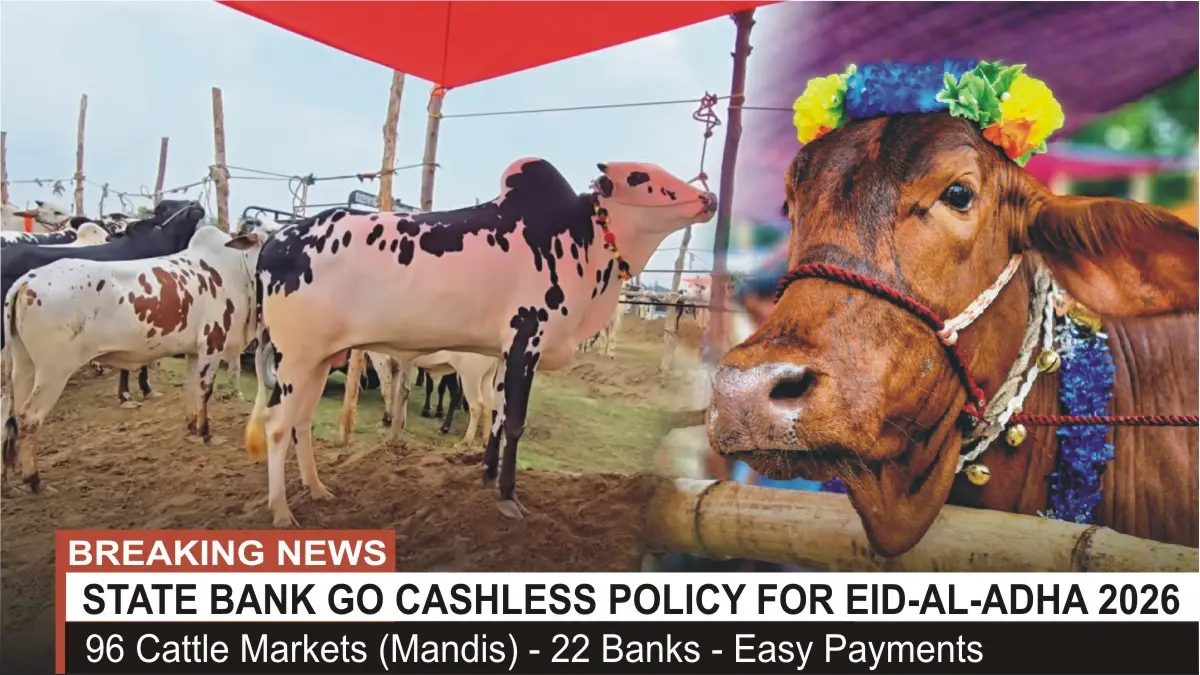
The State Bank of Pakistan has nearly doubled its cashless payments drive this Eid, deploying 22 banks across 96 cattle markets nationwide with relaxed transaction limits effective until June 5.
The State Bank of Pakistan (SBP) has launched its most ambitious cashless payments push yet, expanding its “Go Cashless” campaign to 96 cattle markets across the country ahead of Eid-ul-Azha 2026. This is a significant jump from the 54 markets covered during last year’s campaign and marks a clear acceleration in Pakistan’s drive to digitize everyday financial transactions.
The campaign targets one of the most cash heavy commercial events in the Pakistani calendar. Every year, billions of rupees change hands in cattle markets (Maweshi Mandis) in cities from Karachi and Lahore to smaller towns across Punjab, Sindh, Khyber Pakhtunkhwa and Balochistan. Buyers haggle in cash, sellers pocket thick bundles of notes and transporters are paid on the spot. SBP wants to change that picture.
The initiative runs as part of the central bank’s broader strategy to reduce the country’s dependence on physical currency and bring more economic activity into the formal, digital financial system.
#SBP has launched a nationwide #GoCashless campaign for Eid al-Azha 2026 to promote secure, convenient, and cashless transactions in cattle markets across Pakistan. #SBP encourages public to make use of digital payment channels, including mobile banking apps, branchless banking… pic.twitter.com/JQdG6jzzup
— SBP (@StateBank_Pak) May 15, 2026
What the Campaign Actually Involves
Under the Go Cashless campaign, 22 commercial banks will establish dedicated camps and kiosks inside assigned cattle markets. These setups are not simply ATM points. Bank staff will be present on the ground to open accounts for cattle sellers — known as beoparis — as well as for transporters and other service providers working in and around the markets.
The focus is on onboarding these participants onto digital payment channels, including QR code-based payment systems. A buyer who wants to purchase a qurbani animal will, ideally, be able to scan a code and pay digitally rather than handing over a stack of notes.
To support this, SBP has also introduced a temporary relaxation on transaction and account balance limits. These relaxed limits are effective from May 14, 2026 to June 5, 2026 — covering the entire run-up to Eid-ul-Azha and the immediate post-Eid period. This means customers using mobile banking apps or branchless banking wallets during this window can move larger sums without hitting the standard daily or monthly caps that would otherwise apply.
In addition to bank kiosks, mobile banking vans, ATMs, and Cash Deposit Machines (CDMs) will be deployed at or near cattle markets where logistically feasible.
Source: State Bank Of Pakistan Press Release (dated 15th May 2026)
The Digital Channels SBP Is Promoting
SBP has specifically encouraged the public to use several digital payment tools during the Eid season:
Raast — Pakistan’s instant payment system, which allows person-to-person transfers using a mobile number or CNIC, free of charge. Raast has seen growing uptake since its rollout and is central to SBP’s financial inclusion agenda.
Mobile banking apps — Offered by most major commercial banks including HBL, UBL, Meezan Bank, Allied Bank, and others. Customers can transfer funds, pay bills, and send money directly from their smartphones.
Branchless banking wallets — Services like Easypaisa and JazzCash, which are widely used even among people without traditional bank accounts, particularly in smaller cities and rural areas.
QR code payments — A contactless system where sellers display a QR code and buyers scan and pay through their banking app. This is one of the most practical tools for busy mandi environments.
ALSO READ
New Currency Notes in Pakistan Delayed as Government Rejects Initial Designs
Why Cattle Markets Were Chosen as the Focus
The timing and venue are deliberate. Eid-ul-Azha generates one of the largest single-season concentrations of cash transactions in Pakistan’s economy. According to previous estimates by industry analysts, the livestock trade around Qurbani season runs into hundreds of billions of rupees nationally — most of it entirely outside the digital system.
SBP has recognised this as both a risk and an opportunity. Large cash volumes in crowded public spaces create security concerns for buyers, sellers, and transporters alike. At the same time, the sheer scale of activity means even partial digital adoption during this period can meaningfully shift national transaction data.
The central bank has been running versions of this campaign for several years. Each year, coverage has grown. The move from 54 markets in 2025 to 96 in 2026 suggests the model is working well enough to justify expansion — though SBP has not published specific data on transaction volumes or adoption rates from previous campaigns.
What This Means on the Ground
For a cattle seller (beopari) arriving at a mandi in Lahore, Faisalabad, or Hyderabad, the most immediate change is the presence of a bank camp where they can open an account or activate a digital wallet — often on the same day, with simplified documentation requirements that apply during the campaign period.
For a family heading to the mandi to buy a goat or cow for Qurbani, carrying Rs50,000 or Rs100,000 in cash through a crowded market carries real risk — pickpocketing, loss or simply the logistical difficulty of handling large notes. A digital payment removes that problem, provided the seller is set up to receive it.
For transporters moving animals from rural areas to city markets, payment on delivery is common practice. Mobile wallet transfers offer a faster and safer alternative to cash handovers on roadsides or in market yards.
The relaxed transaction limits that SBP has put in place are particularly relevant here. Standard daily transfer limits on many mobile banking platforms can be a barrier for larger livestock purchases. A bull or cow for Qurbani can easily cost Rs150,000 to Rs400,000 or more in 2026 market conditions. Temporarily lifting those limits makes digital payment a practical option for higher-value transactions, not just smaller purchases.
As Eid-ul-Azha approaches, the real test will play out not in SBP’s policy documents but in the lanes of cattle markets in Karachi’s Sohrab Goth, Lahore’s Shahpur Kanjra, and dozens of smaller mandis across the country — where bank kiosks will have to compete with decades of cash habit.

 By
By
 By
By