
Zil Hajj Moon Sighted in Pakistan — Eid ul Adha 2026 Falls on May 27, Offices Shut for 3 Days
The Central Ruet-e-Hilal Committee has officially confirmed the sighting of the Zil Hajj crescent moon, fixing Eid ul Adha 2026 on Wednesday, May 27 — with a three-day public holiday block running through May 29 across Pakistan.
Pakistan Confirms Eid ul Adha 2026 Date After Official Moon Sighting
The Central Ruet-e-Hilal Committee, chaired by Maulana Abdul Khabeer Azad, met on Sunday evening and officially confirmed the sighting of the Zil Hajj crescent moon across Pakistan. The announcement means that the Islamic month of Zil Hajj — also written as Dhul Hijjah — began on Monday, May 18, 2026, corresponding to 1 Zil Hajj 1447 AH.
As a result, Eid ul Adha 2026 will be observed on Wednesday, May 27, 2026, which marks the 10th of Zil Hajj — the holiest day of the Hajj season and the Festival of Sacrifice.
The confirmation aligns Pakistan’s religious calendar with Saudi Arabia and the broader Muslim world for this cycle, a point that has historically been a source of disagreement in previous years.
Pakistan’s government is expected to issue a formal holiday notification shortly. Public offices, banks, and educational institutions across the country — from Karachi to Gilgit — will remain closed for three consecutive days beginning May 27.
The Full Eid ul Adha 2026 Holiday Schedule in Pakistan
Following the Ruet-e-Hilal Committee’s announcement, the three-day public holiday schedule for Eid ul Adha 2026 in Pakistan stands as follows:
- Wednesday, May 27, 2026 — Eid ul Adha Day 1 (Public Holiday)
- Thursday, May 28, 2026 — Eid ul Adha Day 2, also observed as Youm-e-Takbeer (Public Holiday)
- Friday, May 29, 2026 — Eid ul Adha Day 3 (Public Holiday)
All government offices, federal and provincial ministries, State Bank of Pakistan branches, commercial banks, courts, and schools will be closed on these three days. Normal operations are expected to resume on Monday, June 1, 2026.
It is worth noting that Thursday, May 28 carries additional national significance as Youm-e-Takbeer — the anniversary of Pakistan’s nuclear tests in 1998 — making that day doubly observed across the country.
Day of Arafah: The Most Important Day Before Eid
Before Eid ul Adha arrives, Muslims around the world observe the Day of Arafah — the 9th of Zil Hajj — which is considered the spiritual peak of the Hajj pilgrimage and one of the most significant days in the Islamic calendar.
In 2026, the Day of Arafah falls on Tuesday, May 26, one day before Eid. Millions of Hajj pilgrims in Makkah will gather at the plain of Arafah on that day, fulfilling what is widely considered the central rite of the pilgrimage.
For Muslims in Pakistan who are not performing Hajj, the Day of Arafah is observed through voluntary fasting. Islamic scholars cite a well-known hadith stating that fasting on this day expiates sins from the previous year and the coming year. Mosques across Pakistan typically see larger-than-usual attendance on the eve of Arafah and on the morning of Eid itself.
Government Salaries Will Be Released Early — From May 22
One development that will directly affect millions of government employees, pensioners, and their families is the advance release of salaries.
Because Eid ul Adha falls at the end of May — and the three-day holiday would otherwise delay monthly payments — the Ministry of Finance has already authorised the early disbursement of government salaries, allowances, and pensions for the month of May 2026.
According to official instructions, these payments will begin from Friday, May 22, 2026, five days ahead of the first day of Eid.
This is a standard practice the government follows each time a major public holiday falls near a salary date. The early release is intended to ensure that government employees can purchase sacrificial animals — qurbani — and manage other festive expenses without waiting for month-end payments.
For Pakistan’s roughly 3.5 million federal and provincial government employees, as well as millions of retirees drawing state pensions, this means funds will be accessible before the livestock markets peak in price in the days immediately before Eid.
ALSO READ
SBP Expands Go Cashless Campaign to 96 Cattle Markets for Eid-ul-Azha 2026
What This Means for Ordinary Pakistanis
Eid ul Adha is one of the most economically active periods of the year in Pakistan. Livestock markets — known locally as “mandi” — spring up in open grounds across Karachi, Lahore, Islamabad, Peshawar, Quetta, and hundreds of smaller cities and towns in the weeks leading up to the festival.
With Eid confirmed for May 27, traders and buyers now have a fixed date to work with. Livestock dealers who bring cattle, goats, and sheep from Balochistan, Punjab, and Khyber Pakhtunkhwa to urban centres can plan their transport and pricing accordingly.
For families planning their qurbani — the obligatory sacrifice that marks Eid ul Adha — this is the window in which animal prices typically rise sharply. Markets in Karachi’s Sohrab Goth, Lahore’s Data Darbar area, and Islamabad’s sector cattle markets are expected to operate at full capacity from around May 20 onwards.
Butchers, cold storage operators, and meat distributors — who together form a substantial informal economy during this period — will now align their logistics with the confirmed dates.
Businesses operating in sectors connected to Eid, including retail clothing, sweets, and household goods, will also factor this schedule into their inventory and staffing plans.
Pakistan and Saudi Arabia Now on the Same Eid Date
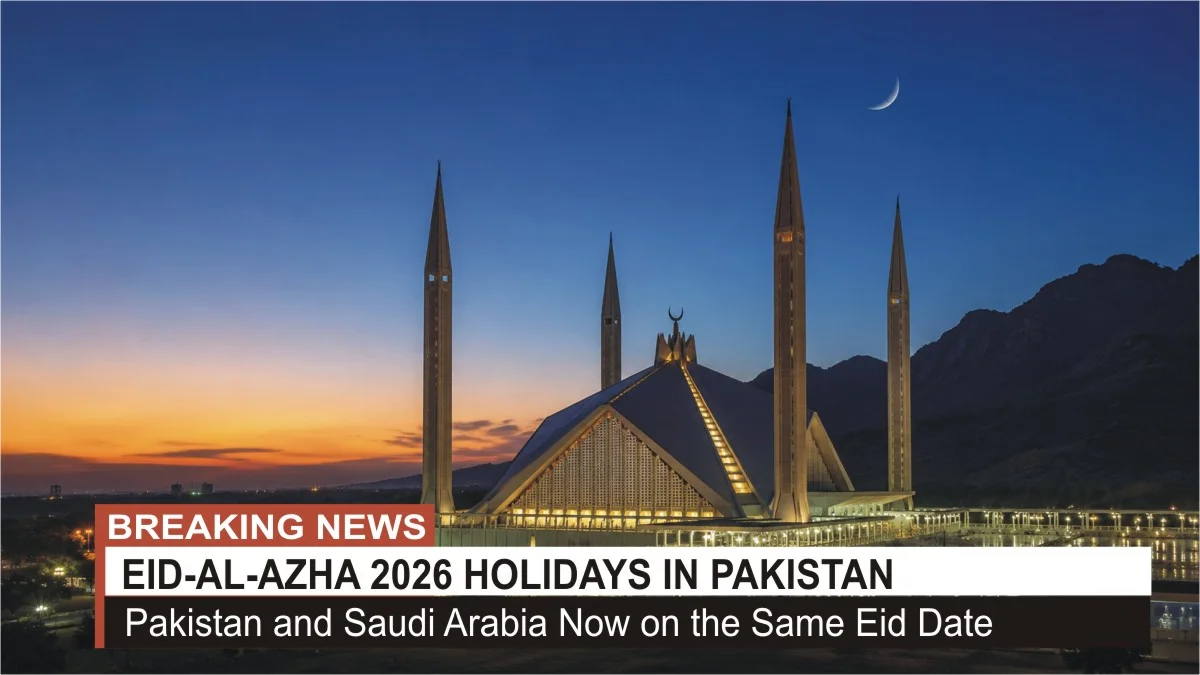
In past years, a recurring source of public debate in Pakistan has been whether to observe Eid on the same date as Saudi Arabia or to rely solely on local moon sighting. The Central Ruet-e-Hilal Committee’s confirmation on May 18 means both countries will observe Eid ul Adha on the same day — May 27 — removing the ambiguity that occasionally leads different provinces or communities within Pakistan to observe Eid on different days.
Saudi Arabia’s Supreme Court had also confirmed the sighting of the Zil Hajj crescent, fixing the first of Dhul Hijjah there as well. With the global Hajj pilgrimage centred in Makkah and Madinah, the alignment means that the Day of Arafah — May 26 — and Eid ul Adha — May 27 — are now synchronised internationally for the 1447 AH cycle.
What to Watch Next
The formal government holiday notification — usually issued by the Cabinet Division and circulated to all federal ministries — is expected within days and will serve as the official confirmation for employers in the private sector as well.
Private sector employees should check whether their companies follow the federal holiday schedule or maintain a separate calendar. Most large corporations and multinationals in Pakistan observe the same public holidays as the government.
For Hajj pilgrims from Pakistan who are already in Saudi Arabia, the Hajj season is now in its final preparatory stages. The day of standing at Arafah — May 26 — is less than two weeks away.
Citizens planning to purchase sacrificial animals should note that livestock prices tend to peak in the 72 hours immediately before Eid. Buying before May 24 typically offers more negotiating room.
Government employees expecting early salary payments should check with their respective departments, as disbursement timelines may vary slightly between federal and provincial payroll systems.
The Eid ul Adha 2026 calendar is now settled. With the moon confirmed, the dates fixed, and salaries arriving ahead of schedule, Pakistan moves toward one of its most significant religious and social occasions of the year.


 By
By
 By
By