
Solar energy was supposed to be the perfect solution to the energy crisis in Pakistan. For years, Pakistanis have invested in solar panels to escape high electricity bills and hours long load shedding.
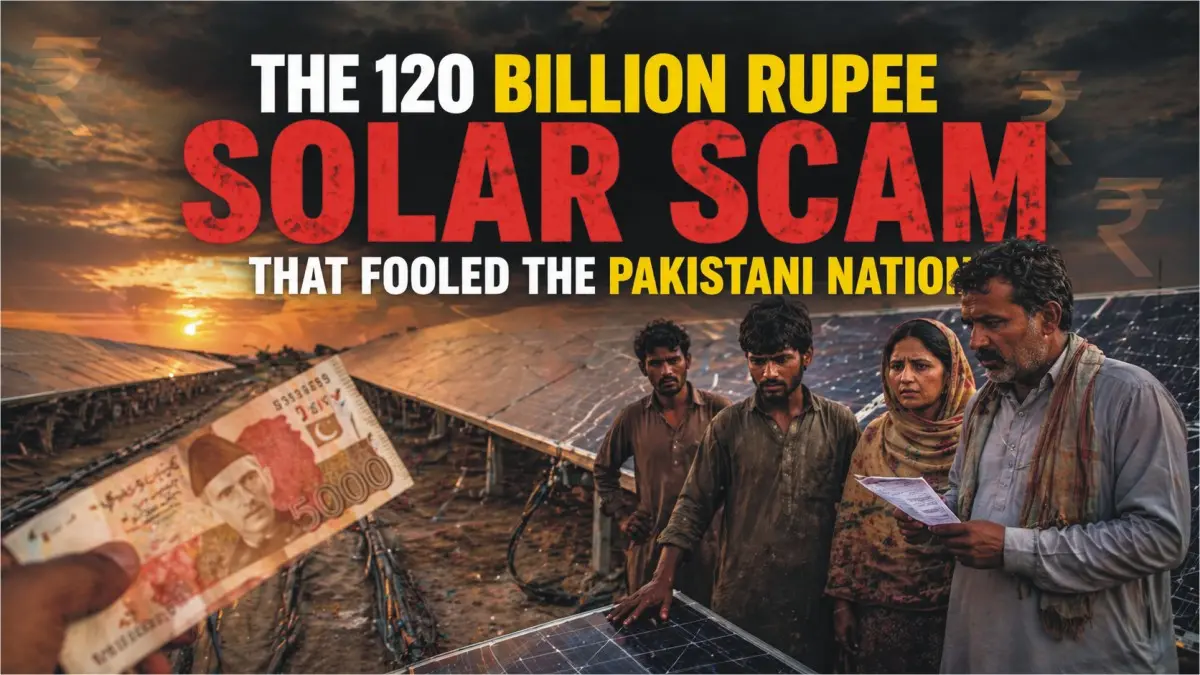
However, this high demand has recently become the center of one of the largest financial crimes in the country. A massive scandal involving 120 billion rupees has surfaced, revealing a deep web of corruption, illegal money transfers and fake businesses.
The Federal Board of Revenue (FBR) recently uncovered this big fraud, which took place over a period of five years. Between 2017 and 2022, criminal networks used the legal import of solar panels to steal money from the national economy. This discovery has shocked the public and forced the government to take immediate, strict action against everyone involved, including government officers who failed to stop it.
How the 120 Billion Rupee Fraud Happened
To understand this massive crime, it is important to know how the criminals used a method called trade-based money laundering. They did this mainly through a process known as over-invoicing. In simple terms, over-invoicing happens when a buyer and a seller agree to state a much higher price on official trade documents than the actual cost of the product.
For example, if a solar panel actually cost 10,000 rupees, the importers would declare the value as 30,000 rupees on the official paperwork. Because they claimed the product was more expensive, they were allowed to send larger amounts of money out of Pakistan to foreign bank accounts. The extra money was not paying for solar panels, it was simply illegal money laundering.
The Directorate of Post Clearance Audit, a special branch of the Federal Board of Revenue, was the agency that finally noticed these strange patterns. They reviewed old import records and realized that huge sums of money were leaving the country through fake or “dummy” companies.
These companies existed only on paper. They had no real offices or actual business operations, but they were legally permitted to import billions of rupees worth of solar equipment. By the time the authorities fully understood the situation, roughly 120 billion rupees had already been moved out of the country illegally.
Government Action and the 111 Billion Rupee Fine
When the details of this massive money laundering operation reached the highest levels of the government, the reaction was immediate. Prime Minister Shehbaz Sharif expressed deep concern over how such a large scale fraud could continue unnoticed for five years. He immediately ordered strict legal action against all individuals and companies involved in the crime.
The authorities have already started punishing the guilty parties. After proving the charges against several dummy companies, the government imposed heavy fines totaling 111 billion rupees. However, the government knows that fining the companies is not enough, because government officials also had to be involved for a crime of this size to happen.
To handle the situation, the Prime Minister has formed two high-level committees. The first is a Disciplinary Action Committee, led by the Establishment Division. This committee’s one specific job is to find and punish the government officers and customs agents who either helped the criminals or failed to do their duty.
The second group is the Monitoring, Investigation and Prosecution Committee. This team is responsible for managing the complex legal cases and tracking the laundered money across international borders. To ensure that these committees work quickly, the Prime Minister has ordered them to submit a detailed progress report every fifteen days.
What This Means for the Future of Solar Power
This scandal has a direct impact on the economy and the citizens of Pakistan. When billions of rupees leave the country illegally, the national currency loses value, making everyday items more expensive for the common person. The public relies on the government to protect the economy, and this incident shows a serious failure in the import checking system.
The next steps for the government are very clear but quite difficult. First, they must recover the 111 billion rupees in fines. Second, the authorities plan to seize the personal assets, such as houses and bank accounts, of the people who made illegal profits from this scam.
Finally, the country’s entire import system needs major reforms. The government must create stronger digital tracking systems to ensure that the declared value of imported goods matches international market prices.
Despite this shocking event, solar energy remains very important for the future of Pakistan. People still need affordable and clean electricity. The goal now is to clean up the import business so that citizens can continue to buy solar panels safely, without their hard earned money being stolen by corrupt networks.
The success of these two new committees will determine if the public can trust the import system again.

 By
By