
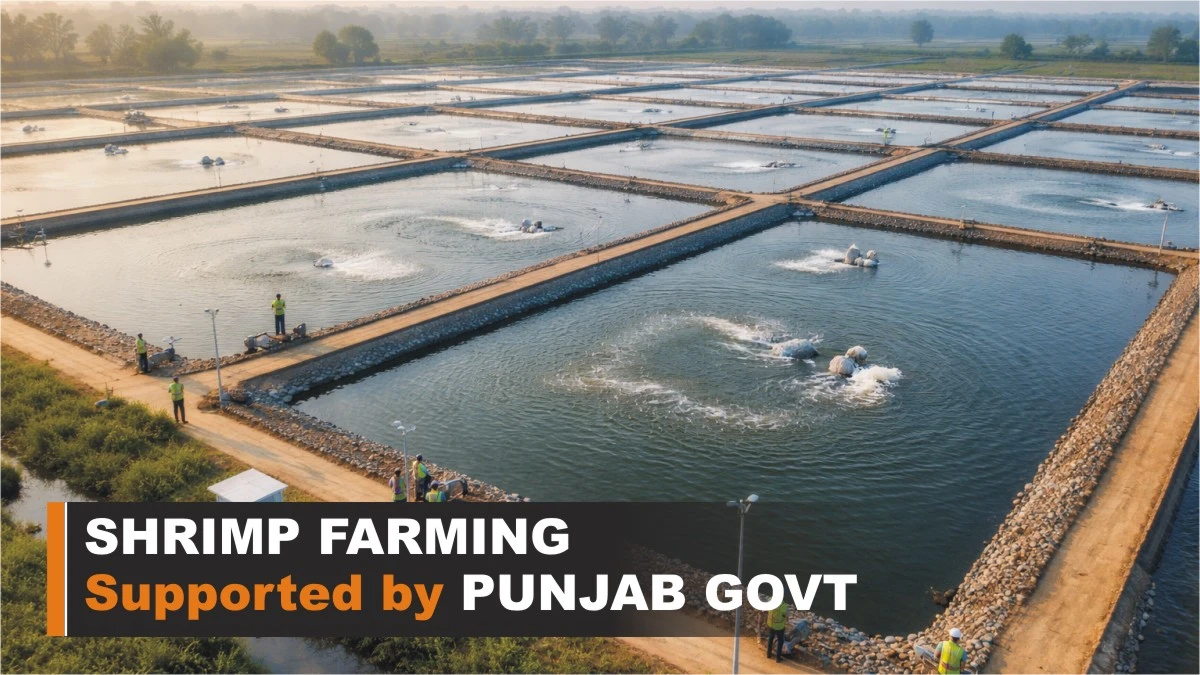
LAHORE – The Punjab government has started a large project to grow shrimp on land that was empty and useless for many years. This project is led by Chief Minister Maryam Nawaz Sharif. The main idea is simple: take barren land, build ponds, fill them with water, and grow shrimp for food and export.
This is not a small trial. This is the first time in Punjab that the government is directly running a modern, science-based shrimp farming project. Experts have already checked the water temperature and quality. They say the conditions are good for shrimp to grow.
The project is spread across three main locations: Sargodha, Ali Wala, and Shahgarh. Work started some time ago, and now most of the construction is finished or near completion.
Progress at Three Locations: Ponds, Roads, and Water Supply
The largest site is the Sargodha Shrimp Estate. It covers 500 acres of land. According to official progress reports, workers have completed excavation of 118 out of 126 planned ponds. The embankments, which are the small walls around each pond to hold water, are 92 percent ready. Tube wells are important because they bring water to the ponds. Boring of 116 tube wells is finished. The water supply system is 92 percent complete.
The government also cleared and surveyed 365 acres of land at Sargodha. A road of 2,020 meters is being built. The groundwork for this road is finished. A warehouse, where feed and equipment will be stored, is 90 percent complete. Other buildings are still under construction.
The second location is the Ali Wala Shrimp Estate. This site is bigger in land area. Total land is 1,267 acres. Here, 90 percent of the land has been cleared. Out of 737 planned ponds, 642 are already completed. The drainage system, which removes extra water, is 91 percent finished. A road network of 9,000 meters has been surveyed, and 80 percent of earth filling for these roads is done. Boring of 317 tube wells is complete. Basic buildings like an admin office, a hostel for workers, a warehouse, and labor residences are fully finished.
The third location is the Shahgarh Shrimp Farm. Here, water supply work is 90 percent complete. Electrification is 95 percent done. Road construction is 97 percent finished.
These numbers show that the project is not just a plan on paper. It is almost ready to operate at full capacity.
Daily Shrimp Feeding and First Results
The project is not only about construction. Shrimp are already in some ponds, and experts are taking care of them every day. The shrimp are given 114 kilograms of feed daily. This feed is measured carefully. Too little feed will slow growth. Too much feed will waste money and dirty the water.
Along with normal feed, workers also add supplements. Supplements are special mixtures that help shrimp grow faster and stay healthy. Experts say the results so far are encouraging. Both the production amount and the quality of shrimp are improving.
This is important for Pakistan. If the quality is good, then these shrimp can be sold to other countries. Exporting shrimp brings foreign money into Pakistan. It also reduces pressure on sea fishing, because farmed shrimp do not come from the ocean.
| Claim Made | Status | Source of Verification |
|---|---|---|
| 118 out of 126 ponds excavated in Sargodha | Confirmed | Punjab government infrastructure progress report, March 2026 |
| 92 percent embankments ready in Sargodha | Confirmed | Same government report |
| 642 out of 737 ponds completed in Ali Wala | Confirmed | Project monitoring data as of March 2026 |
| Shrimp receive 114 kg of feed daily | Confirmed | On-site expert statement to news media |
| Water temperature is suitable for shrimp farming | Confirmed | Pre-project feasibility study by aquaculture experts |
| This is Punjab’s first government-patronized shrimp farming project | Confirmed | No previous large-scale government-led shrimp farm exists in Punjab |
All data in this article comes from publicly announced government reports and news coverage by Dunya News. No numbers have been exaggerated. However, long-term success will depend on disease control, market prices and continuous training for workers. Those factors are not yet fully known.
Jobs, Exports, and What This Means for Common People
For a normal person in Sargodha, Ali Wala, or nearby villages, this project brings direct benefits. Jobs are created at multiple levels. Construction workers built the ponds and roads. Now, workers are needed to operate tube wells, distribute feed, monitor water quality, and harvest the shrimp when they are fully grown.
The government has not released an exact job count yet. But based on similar shrimp farming projects in other countries, a 500-acre farm can create 300 to 500 direct jobs. Indirect jobs include truck drivers, ice suppliers, packaging workers, and local sellers. This means a young person in rural Punjab may not need to move to Lahore or Karachi for work. They can find employment near their home.
Exports are another big benefit. Pakistan currently does not export large amounts of farmed shrimp. Countries like Vietnam and Thailand earn billions of dollars from shrimp exports. Pakistan has the land, water and now the government support. If this project succeeds, it will open new export routes to China, the Gulf countries, and Europe.
Chief Minister Maryam Nawaz Sharif appreciated the pace of work. She said that world-class shrimp farming will turn Punjab into a key hub of aquaculture. She also said it will help reclaim barren lands while boosting employment and exports.
However, it is also honest to mention the risks. Shrimp can die from viruses. If one pond gets infected, the disease can spread. Water quality must be checked daily. Electricity costs for running tube wells can be high. International buyers are strict about quality and safety. The government says it has experts to handle these challenges, but only time will tell if the project remains successful.
For now, the facts are clear. Ponds are built. Roads are ready. Shrimp are being fed. Barren land is no longer useless. This is a real change, and it is happening now in Punjab.

 By
By