
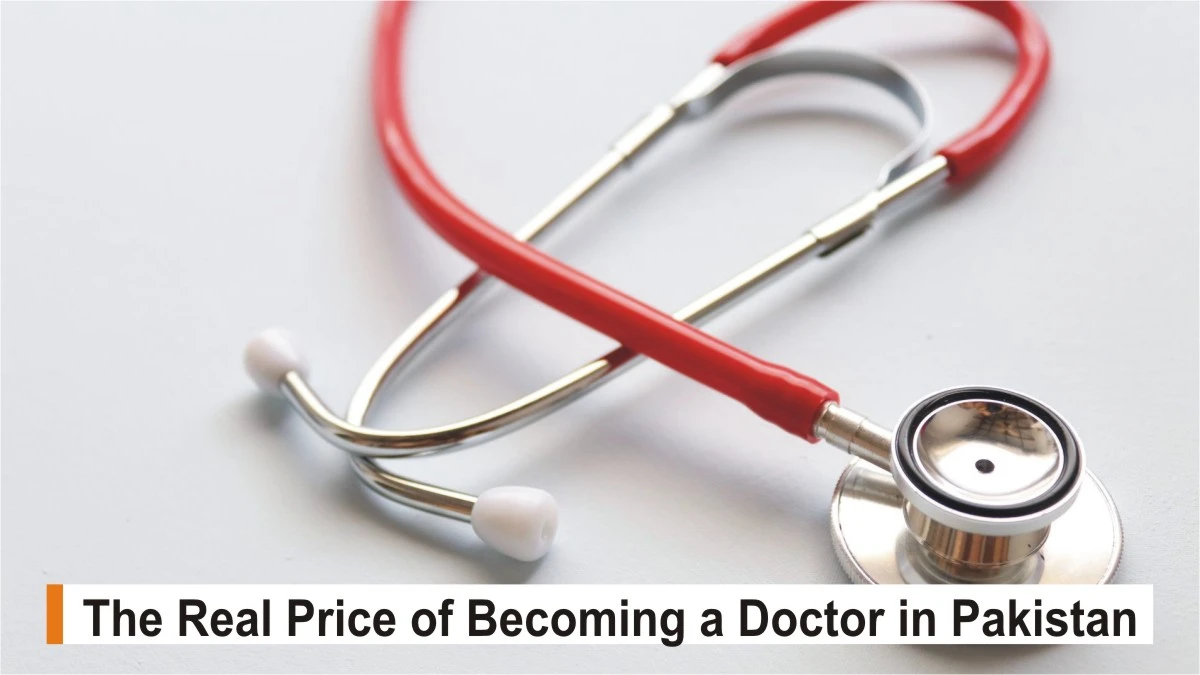
The Pakistan Medical and Dental Council has capped private medical college fees at Rs1.89 million a year — but many colleges are still charging more. Here is what MBBS actually costs right now, and why MDCAT 2026 has also just moved to September.
If you are a parent budgeting for MBBS, or a student who registered for this year’s entry test, the honest answer to “how much does it cost” now depends less on which province you’re in and more on which regulation is actually being enforced.
Government medical colleges in Pakistan still charge close to nothing — often under Rs100,000 a year. Private colleges are supposed to charge no more than Rs1.89 million a year under a cap the Pakistan Medical and Dental Council (PMDC) put in place after a Prime Minister-ordered review. But PMDC’s own president has confirmed the council is issuing show-cause notices to colleges that are ignoring the cap.
What actually changed
In 2025, a Committee on Medical Education Reforms — formed on Prime Minister Shehbaz Sharif’s directive and chaired by Deputy Prime Minister Ishaq Dar — recommended that private medical and dental colleges stop charging tuition fees freely. PMDC accepted the recommendation and fixed the tuition fee, including ancillary charges, at Rs1.8 million for the 2024-25 session, rising by 5% to Rs1.89 million for 2025-26. From the 2026-27 session onward, any further increase is supposed to track the Consumer Price Index rather than being set by colleges themselves, according to The Express Tribune and Dawn.
Colleges that believe their costs justify more can apply to PMDC for an enhanced fee of up to Rs2.5 million, but only with audited financial accounts to back the request, per Business Recorder. Under this process, PMDC has already approved higher fees for some institutions — for example, Akhtar Saeed Medical College at roughly Rs2.14 million and Islamabad Medical College at roughly Rs2.15 million — while postponing decisions for others, including Aga Khan University, pending complete documentation, according to Bloom Pakistan.
This is not a settled matter. Some private colleges challenged the cap in the Islamabad High Court and won a stay order, and PMDC President Dr Rizwan Taj said in February 2026 that the council had issued show-cause notices to 12 institutions still charging above Rs1.8 million, with roughly 40 more cases under review, per The Express Tribune. As recently reported that parents in Islamabad, Lahore, Karachi and Peshawar being asked for Rs2.5 million to over Rs3.5 million upfront despite the cap.
What this means for you: if a private college quotes you a first-year fee above roughly Rs1.9 million without showing you a PMDC-approved exception, that is worth questioning before you pay. PMDC accepts complaints about overcharging through its portal at pmdc.pk/ContactUs/Complaint.
Government colleges: still the cheapest route
Public sector fees have not seen the same upheaval. Across most public medical colleges — King Edward Medical University, Dow University of Health Sciences, Allama Iqbal Medical College and others — annual tuition generally falls somewhere between roughly Rs20,000 and Rs100,000, according to official Punjab government fee notifications compiled by MDCAT Mentor and individual university fee pages. Add hostel and mess costs, and a five-year public-sector MBBS remains, by a wide margin, the more affordable path — though seats are extremely limited and competition is intense.
The extra costs that catch families off guard
Whichever sector you’re in, tuition is rarely the full bill. On top of it, students typically pay:
- A one-time, non-refundable admission fee at enrollment
- Annual university registration and examination fees to the affiliating university (UHS, KMU, JSMU, DUHS and others)
- Hostel and mess charges, billed separately from tuition
- Books, a stethoscope, lab coat and dissection kit
- A refundable security deposit
Private colleges also apply late-payment penalties if fees aren’t paid on time — Dow Medical College’s published schedule, for instance, adds a percentage of the tuition fee for each month a payment is delayed, according to DUHS’s own admissions page.
MDCAT 2026 has moved — mark the new date
If you were preparing for MDCAT on 16 August, that date no longer applies. PMDC officially postponed the exam to Sunday, 20 September 2026, in a notice issued 6 August 2026 on the Prime Minister’s instructions, aimed at making the exam “more transparent and organised.” All other terms, eligibility rules and exam arrangements stay the same — only the date changed, PMDC said. This is confirmed by Geo News, Samaa and The Nation.
Around 135,000 candidates are expected to sit the test across roughly 36 centres, including one in Riyadh, according to Senate subcommittee briefings reported by The Nation. Admission still runs on PMDC’s standard merit formula: Matric marks count for 10%, F.Sc (or equivalent) for 40%, and the MDCAT score for 50%.
On the passing threshold itself, reporting has varied by session and PMDC has adjusted it more than once recently — including a one-time relaxation for the 2025-26 session to help fill vacant seats. Candidates should confirm the exact current passing percentage on PMDC’s official MDCAT portal, mdcat.pmdc.pk, closer to results, rather than relying on last year’s figure.

The bottom line for families
- Public MBBS: roughly Rs100,000–Rs300,000 total tuition over five years, plus hostel — the cheapest route, but seats are scarce and merit is high.
- Private MBBS: officially capped around Rs1.89 million a year (roughly Rs9.5 million over five years before ancillary costs), though enforcement is uneven and some colleges are still charging more — check any quote against PMDC’s approved list before paying.
- MDCAT 2026: now 20 September 2026, not 16 August.
FAQ
Is the Rs1.89 million private-college fee cap actually being enforced?
Partly. PMDC has issued show-cause notices to colleges charging above the cap and says roughly 40 more cases are under review, but some institutions have court stay orders against the cap, and parents have reported being asked for more than the approved amount as recently as January 2026.
Can a private college legally charge more than Rs1.89 million?
Only if PMDC has approved a higher fee — up to Rs2.5 million — based on the college’s audited financial accounts. Ask to see PMDC’s approval before paying above the standard cap.
When is MDCAT 2026 now scheduled?
Sunday, 20 September 2026, after PMDC postponed it from the original 16 August date.
How is MBBS admission merit calculated?
Matric marks (10%) + F.Sc or equivalent marks (40%) + MDCAT score (50%) = aggregate merit score.
Where do I report a college overcharging?
Through PMDC’s official complaint portal at pmdc.pk/ContactUs/Complaint.

 By
By